
So, you think you’ve done the hard work as an organization. You’ve got a competent IT security team that ensures your important data and communications are encrypted. The tools you use are encrypted. Encryption falls into the CIA triad, and it seems pretty foolproof, right? Wrong. There are quite a number of different types of security attacks in cryptography that can cause untold financial damage to a business. This article explores six of them.
Before going further, imagine you are the senior manager of a major organization. You are working from home because of a global pandemic, and you need to talk to another senior manager about an upcoming product launch. It’s March, 2020. Your IT security team has informed you that the Zoom tool uses encryption, so it’s secure enough to speak about sensitive information with your colleague.
What the IT security team failed to realize was that Zoom’s encryption methods were vulnerable. Any sophisticated cybercriminal could’ve heard your conversation and leaked company secrets. This is why it’s so vital to know about the susceptibility of encryption to attack.
Different types of attacks in cryptography
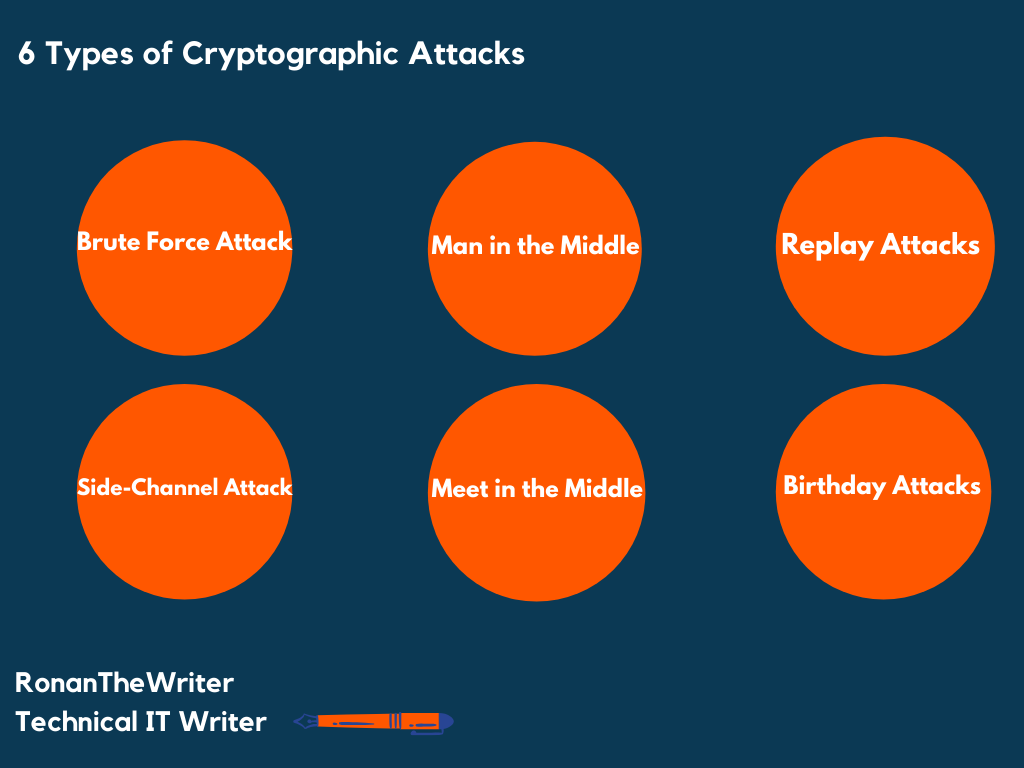
This is a non-exhaustive list of the different types of attacks on cryptographic systems. Cryptographic attacks are an advanced area of IT security but it’s extremely important for SME businesses, enterprises, and organizations to know about them and attempt to mitigate them.
1. Brute Force Attack
Of all the types of security attacks in cryptography, a brute force attack is the most straightforward conceptually. Brute force attacks use a huge amount of processing power to guess every possible combination and crack the key used to secure encrypted communications. The goal is to be able to read the plaintext, which may contain highly sensitive information, such as intellectual property or trade secrets.
From an IT security perspective, the worrying thing about a brute force attack is that given enough time, it will almost always be successful. However, the length of time it takes to crack the key is proportional to the length of the key. So, a good way to prevent a successful brute force attack is to use long keys.
When cybercriminals carry out brute force attacks, they normally do it using a huge network of distributed computers. They also deploy rainbow tables, which are pre-computed tables of cryptographic hashes, to speed up the brute force attack.
An important preventative measure for IT security teams is adding cryptographic salt to hashed passwords. Cryptographic salt is a random value appended to the end of user passwords or other confidential information before being hashed. Using cryptographic salt slows down brute force attacks dramatically because the attacker needs to guess the salt aswell.
2. Man in the Middle
A man in the middle attack is when a malicious party intercepts the secure communications between two parties without either party knowing that their communications have been compromised. Man in the middle attacks attempt to exploit a lack of authentication, and they usually happen when parties communicate over WI-Fi access points.
From an enterprise perspective, the increased use of mobile devices connected to the corporate network increases the chances of a successful man in the middle attack. Employees might unknowingly use insecure public Wi-Fi to connect to your network and exchange sensitive information.
One way to prevent man in the middle attacks is to use public-key cryptography, which provides strong authentication for connections to corporate services. Endpoint protection is important too.
3. Replay Attack Explained
In a replay attack, an intruder intercepts an encrypted message between two parties and replays the intercepted message hoping to start a new session. By starting a new session, the intruder can create duplicate transactions or bypass authentication and access systems. This is one of the types of attacks in cryptography that targets the security protocol used.
For example, a customer of an online bank might send a message with their login credentials, which gets intercepted. The attacker can attempt to replay the intercepted message to the bank. Without effective security controls, the bank might grant access to the attacker, who can transfer funds from the victim’s account using their login credentials.
The way to prevent replay attacks is to always use a session ID, timestamp, or one-time password for each encrypted message. For example, if each encrypted message has a unique session ID, the attacker cannot replay a communication because doing so creates a new session ID.
4. Implementation Attack
An implementation attack does not mathematically target the structure of cryptographic algorithms or their input/output values for weaknesses, as is common for many different types of attacks in cryptography. Instead, an implementation attack targets devices that perform cryptographic operations, such as SSL accelerators, USB tokens, and hardware security modules.
The most common type of implementation attack is a side-channel analysis attack. A side-channel attack attempts to understand and use physical information about cryptographic devices, such as power consumption, to access secret keys or plaintext.
Preventative measures for implementation attacks require some physical IT security acumen. It’s prudent to enclose cryptographic hardware so that acoustic information about their operation is inaudible. For attacks that analyze the power consumption of cryptographic devices, a possible countermeasure is to change a device’s power consumption characteristics. This way, intruders can’t easily draw correlations between power consumption and the information on a cryptographic device.
5. Meet in the Middle
Despite sounding similar to a man in the middle attack, a meet in the middle attack is very different and highly complex. A meet in the middle attack targets symmetrical encryption algorithms that use two or more rounds of encryption in a sequence.
The meet in the middle attack targets intermediate values in such algorithms and attempts to make it easier to conduct brute force attacks. This attack depends on knowing the plaintext used in a particular communication. Eventually, the attacker can break the cipher and decrypt any message sent using the cracked cipher.
6. Birthday Attack
The birthday attack is an interesting type of cryptographic attack that exploits the famous birthday problem in probability theory. Without delving into the math behind the problem, the results are that in a group of 23 people, there’s a 50% probability any pair will share a birthday, and that probability reaches 99.9% with just 70 people.
A birthday attack in cryptography uses the mathematics of the birthday problem to exploit hashing functions and find matching pairs of inputs that lead to the same hashed values. Attackers commonly use birthday attacks to forge digital signatures.
A preventative measure is to make the output of a hash function so long that an attack using the birthday problem cannot succeed computationally.
Closing Thoughts
While it’s true that most types of security attacks in cryptography target large enterprises and businesses where significant amounts of money are involved, the sophistication of these attacks doesn’t make smaller companies immune. Bear in mind the Zoom example at the beginning of this article, and take steps to understand and prevent the main types of security attack in cryptography. Your company’s sensitive information—and that of your customers—is at stake.
.
If you enjoyed this article and you’d like me to write an engaging, well-researched article or blog post for your business on any technical IT topic, you can email me now by clicking the below button:
Get in Touch
4 thoughts on “Security Attacks in Cryptography: Six Different Types”
Comments are closed.